“It’s a sad, funny feeling … “

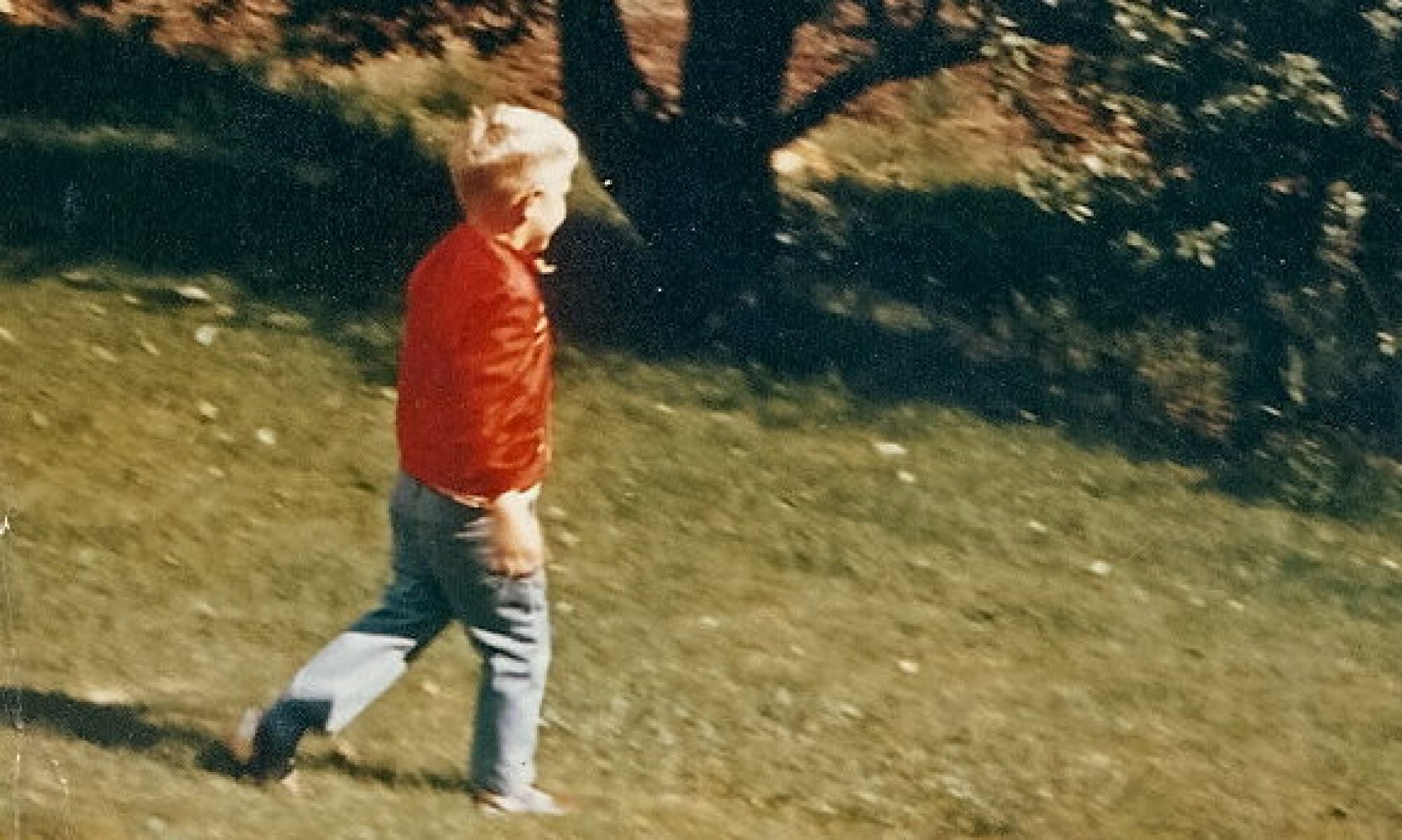
“… now I’m older than him.” I didn’t write that … Amanda McBroom did. Lyrics to a song about her father. I love that song. Days like today.

The air smells like mud. It brings me back to the time … almost 26 years to the day … that my father died. It was an early spring in Montana. Those were rare 26 years ago. Now, thanks to the hole in the ozone layer, they probably happen more frequently.

Anyway, the air today … smells like mud. Just like it did the morning I drove my dad’s run-down car back to Anaconda from Missoula. I hadn’t spoken to my mom since my sister had called me (at a dress rehearsal) and told me my dad had died. And suddenly I felt that sensation. It’s a total cliche, but completely true. When my sister told me the news, I fell down on the ground … because it felt like the ground had fallen out from under me. I felt as though I had nothing left to stand on. Amazing how metaphors can actually happen, right?

I’ve now been alive longer without my dad than I was with. And it’s a sad funny feeling. The other day I confessed to Alana why I don’t like sharing food. It’s because my dad used to beg tastes and swallows of whatever I was eating or drinking. He’d say, “Give me just a swallow of that, would ya?” or “Let’s have a taste of that.” Drove. Me. Nuts.

But whenever I grunt a little when I bend down now to pick something up, or whenever I bounce my hand on a table top — from a fist to a flat hand and back — well … it’s a little uncanny. And a little unsettling. My dad.

My poor old dad.

Posted in Memoir | 1 Comment

Excerpt from Smelter City Boy

Writing a memoir gives me a odd kind of self-reflection. There are people and there are memories of people and there are memories that flash through your mind everytime you see those people. This chapter is for my girl friend, Mary Sue. I recently saw her on-stage, after a number of years. She’s captivating.

You all know I have a dishwashing fetish. This is how it all began:

_______________________________________

Hideaway

June, 1978

Dinner was over, and I’d put in my requisite hour on the piano, while Mom did the dishes. It was a weeknight, school was out, and I had the car. That could only mean one thing.

“Is Mary Sue there?” I asked. Her grandmother had answered the phone.

“Hold on,” she said. Then I heard her say, “It’s for you dear.”

“This is Mary Sue,” she sang into the phone, putting an extra ew on Sue.

“Coke and smoke?” I asked just loud enough for her to hear, but for my folks to ignore.

“Sure! There’s a party at John Tracey’s tonight, but it doesn’t start until late,” she said.

“I’ll come get you,” I said.

“I will be waiting,” she sang.

This was, by far, my favorite thing to do. I’d head out, pick up Mary Sue and we’d drive down Fourth Street, around Ben Goodman Park, out to the turnaround at the Armory and up commercial to either Main Street or up as far as Cedar Street, where we’d loop back onto Fourth. The entire loop around Anaconda would take about fifteen minutes. Twenty if we hit the light at Fourth and Main. We’d cruise the drag and smoke and talk and sing to the radio.

I always described Mary Sue as my girl friend, whenever anyone asked about our relationship. Then I’d say, “In the truest sense of the word. She’s a girl. And she’s my friend. She’s my girl friend,” I’d say. We were completely platonic. A tall, red-haired vixen, Mary Sue and I were interested in the same things. She had tons of soundtracks to movies and Broadway shows. We were in band together (Mary Sue was the drum major), and we had been in plays together at school and at the Anaconda Community Theatre.

We thought so much alike, we’d often finish each other’s sentences.

Mary Sue had one thing I didn’t have, though. She had friends. Tons of friends. She was the type of person who made friends easily. I think she actually liked people. I was quite the opposite. We were a pretty odd couple, but I loved being with her. We’d stop at Lu’s Drive In and get fountain Cokes. Then we’d drive around and around town.

“Oh! Listen to this song. I love this song. It’s country, I know, but I just love the lyrics,” she said when she climbed into the front seat of the Hornet.

Eddie Rabbit was singing I Love a Rainy Night. It wasn’t my favorite song. I didn’t like many of the songs on the radio. But Mary Sue had a really great ear for music, so I pretended to think the song was good.

“We have to pick up Mary Shaun at the Hideaway before we head to John’s,” Mary Sue said.

“Did she go out to eat?” I asked. The Hideaway was the new restaurant in the remodeled Marcus Daly Hotel. The history of the hotel was a paradox. An interesting mix of fact and folklore in Anaconda.

Marcus Daly built the Montana Hotel in 1889 as a premiere European-style hotel. It was a place for visiting dignitaries and mining executives. In its day, the Montana Hotel was one of the most oppulant, civilized places west of the Mississippi River. On the corner of Park and Main Streets, it was four stories tall, had a huge dining room, a coffee shop and a big, ornate bar, carved out of a single piece of solid oak. The Tammany Lounge was named for Marcus Daly’s favorite racehorse, the face of which was in-laid into the bar floor, using tiny wooden tiles. Depending on who you talked to, it was either good luck or back luck to step on Tammany’s portrait.

In the sixties and seventies, the hotel had fallen into decline. The dining room closed. The hotel rooms were rarely rented, and a motel was built in the back parking lot. The succession of owners renamed it the Marcus Daly Hotel long before I was born. In the late seventies, a developer bought the hotel and started ripping it apart. This was looked on with both favor (as a sign of progress) and disdain (so much history gone to waste). The original shell of the building remained, but the main floor was split between retail shops and the Hideaway Restaurant—a brand new, state-of-the-art kitchen, dining room and bar, built in the far corner of the ground floor, where the banquet facilities had once hosted elegant balls and lavish dinners.

“What?” Mary Sue was busy listening to the radio.

“Did she go there to eat?” I said. “I hear the food’s pretty good.”

“No! She works there,” Mary Sue said.

“What?”

“Yeah. She got a job there washing dishes,” Mary Sue said.

“Wow. Cool. OK,” I said. “What time do they close?”

“You know, I don’t know. I think she said we should stop by around 9:00,” Mary Sue said. “This song reminds me of a beatnik kinda song. I mean I can just snap my fingers to it, you know?”

She really loved that song.

We drove around for about an hour before stopping in at the Hideaway. The place was really nice. The furniture was new, and the developer had taken all the interior walls of the hotel down and sand-blasted the brick. There were huge, arched windows in the dining room with long sheer curtains covering them. The kitchen was all new. All the appliances were stainless steel. The big Hobart dishwasher had a levered door you could pull down with one hand. It looked like you loaded the dirty dishes on blue grates, slid the grates into the Hobart, pulled down the doors and waited for the cycle to end. I’d never seen anything like it.

Mary Shaun O’Leary was fairly buried in bus tubs of dirty dishes. The cook was gone, having closed the restaurant at 8:00. There was a single bartender on duty in the lounge. Apparently Mary Shaun was supposed to finish the dishes, haul out the garbage, sweep and mop the floor. Then she was supposed to tell the bartender she was done for the night. But from the looks of it, she was far from ready to do that.

The deep sinks were filled with hotel pans and dirty pots. There were five or six bus tubs stacked with dirty dishes … filled to overflowing. Mary Shaun pulled down the Hobart doors, the water whooshed into the machine and she spun around to face us. A lock of curly brown hair had fallen across her forehead.

“This totally bites,” she said. “I’m not going to be ready to go for at least another hour, maybe two.”

“Wow. You must have been busy, huh?” Mary Sue said.

Mary Shaun looked around the kitchen and squinted. “Not really. It’s always kind of like this at closing. The bus boys just keep coming with the dirty dishes and the cooks just keep piling dirty pots and pans in the sink!” She was clearly overwhelmed.

I looked over at the gleaming, flat-top grill. The make table and deep fryers were pristine, compared to the dish area. The whole room wafted fried chicken. Like someone had make dinner and turned the volume on smell up to high. I squinted like Mary Shaun. I could easily see how two people had stood between the grill and the make table all night. I could see how the bus boys had brought their loads of dishes in one door and left by the other door which led to the wait station. This is so cool, I thought.

“This job sucks,” Mary Shaun said. “I’m not going to be able to go to Tracey’s. I probably won’t be home until midnight at this rate.”

“What do I do?” I asked.

“What?”

“Tell me how you do this?” I asked.

“Do what?” Mary Sue asked.

“This. All this. Tell me what you do,” I said to Mary Shaun. I gestured out over the field of dirty dishes. “Show me how to wash these dishes,” I said. I pointed to the tub of soaking silverware. “Do you sort that before you wash it, or after?” I asked.

Mary Shaun turned her head slightly to one side, looking at me out of the corner of her eyes. “What?”

“Before or after? They seem to just be thrown into that tub every which way. There’s a sorter, right? Do the bus boys not sort the silver when they put it in there? Or do you leave it soak unsorted, then wash, then sort, or do you sort, then wash?”

“You’re putting me on, right?” Mary Shaun said.

“No! I want to know! In fact, why don’t you let me clean these up and you go to the party,” I said.

“But this is my job,” Mary Shaun said to Mary Sue.

“Oh, yeah. I know that, but I don’t want to go to the party, and you do. And you don’t want to wash these dishes and I do,” I said.

“But I’m getting paid to do this,” she said.

“I know! You can keep the money. I just want to wash the dishes.”

“OK, you’re clearly shittin’ me, right? No one wants to wash dishes,” Mary Shaun pushed her hands into the front pockets of her smock.

“I do,” I said.

“Grant …,” Mary Sue started to say something, and stopped herself.

“You can’t do it for me,” Mary Shaun said.

“Well, what can I do to help you?” I asked.

Mary Shaun looked at me sideways again. “You want to help me?” she asked.

“Sure! I’ll help you. We’ll help you.” I pointed between Mary Sue and myself.

We all thought about it for a few seconds.

“Well, if you sent through the tubs and sorted the plates by size and stacked them there, that would be great. Also, once the silver-sorter gets full it’s time to drain the machine and refill it with new water. You’re not supposed to wash the silverware in used water. If I can get you started on the dishes, I can take a whack at the pots and pans. Mary Sue, you can dry, I guess,” Mary Shaun said.

“Let’s go!” I said. Try as I might, I couldn’t hide the fact that I was thrilled at the thought. Within a half-hour I’d broken into a sweat and the three of us were working in perfect, synchronized rhythm. By the time 10:00 rolled around, the dish area sparkled and I was an expert.

The next night, Mary Shaun continued training us on how to close the restaurant. We had to sneak past Kevin, the bartender, who was likely to tell Ruthie, the owner, that Mary Shaun had help closing the kitchen.

After three more shifts, Mary Shaun had almost a week off. I found myself getting antsy around 8:00. I’d drive by the Hideaway and slow the Hornet to a crawl, stalking the place. I checked whose car was in the parking lot, who was bartending. Who could possibly be using my Hobart? I asked myself.

Two more days passed with no dishwashing. That afternoon, a Thursday, the phone in the kitchen rang just before General Hospital started on the TV. My entire circle of friends were completely absorbed by Luke and Laura, and it was one of the few things B.J. and I didn’t argue about. We knew where we’d be at 1:00 on the weekdays. Since B.J. had her own line in her bedroom, I knew the phone was probably Mom calling to tell me what to do to start dinner. I was surprised when Mary Shaun said hello.

“Hey! What’s going on?” I asked.

“Can you do me a big favor?” she asked. She skipped the niceties and got right down to business.

“What do you need?” I asked. Mary Shaun hardly ever needed a ride anywhere.

“I need you to work for me tonight,” she said.

“Excuse me?” I asked. My heart started racing a bit.

“I’m stuck at the lake and my shift starts at 4:00. I can’t come in. It’s the only shift I have this week and I can’t get fired from this job. Please work for me. Please.”

“I can’t just work for you. I mean, I can do the work, but I can’t just show up and start working there like I have a job or anything,” I said.

“Look. I already called Ruthie and explained the situation. I told her you knew what you were doing and let her know that you knew how to close. The cook tonight is Robin. She’s really nice. I think you’ll like her.” I heard a car honk somewhere behind Mary Shaun. “Look, I gotta go,” she said. And the line went dead.

“Unbelievable. Un-fucking-believable,” I said.

“What’s that?” B.J. said.

“I think I just got a job at the Hideaway,” I said.

“Waiting tables?”

“No. I don’t want to be a waiter. I think Mary O’Leary just gave me her job washing dishes,” I said.

“Eeew,” B.J. said.

“I couldn’t be happier,” I said.


***

Ruth Perinni looked up from the four-top she had set up between the kitchen and the salad bar. I had nothing but respect for her. She’d been a fixture at the hotel, working there for as long as I could remember. Mom and I used to go to breakfast after church at the hotel with Margaret Bubash and her daughter Cynthia. If Ruthie didn’t wait on us, she was in the kitchen making our breakfast. When the hotel closed and started getting ripped apart, we stopped going there for Sunday breakfast. Eventually, I stopped going to church altogether.

“I’m Grant. Grant Byington,” I said.

“Oh I know who you are,” Ruth said. She smoked the same kind of cigarettes as Mom. She spoke slowly and deliberately. It was clear I would have to choose my words wisely around her.

“My dad is Bob Byington,” I said.

“I said I know who you are,” she repeated.

“Mary Shaun said she talked to you about my working for her tonight,” I said.

“She said no such thing,” Ruth said. She stuck a match and touched the end of her Virginia Slim.

“She called me around noon and asked if I could work for her. She told me she’s squared it with you, or I never would have come here,” I said.

“Are you the man who’s been closing for her?” Ruth asked.

“I haven’t been closing for her, but I have showed up a few times at the end of her shift and helped her take out the garbage and stuff like that,” I said.

“You know know how to run the machinery?” Ruth asked.

“Oh the Hobart? Yes. I know how to do that. I know how to stack the dishes and use the rubber ring. I rinse before I load. I find the dishes are cleaner that way. I am a bit rusty on how long to soak the pans, though. Mary Shaun usually does that part. And I know about the oil in the broaster and the solution to mop the floor. I guess I know how to close, but I’ve never closed for her. She’s a good friend of mine. She’s the secretary of the band, did you know that? She’s really a responsible person. I don’t think she would have called me if she wasn’t in some kind of jam,” I said.

“She didn’t tell me she was in trouble,” Ruth said.

“Oh? I don’t think she’s in trouble. I just think she’s stuck out at the lake. Her car is probably stalled or something. He’s really a responsible person,” I said again.

“I’ll be the judge of that,” Ruth said. She looked around the dining room. Ron Cron, the bus boy, was setting up the salad bar. I could hear Robin the cook talking about the specials to Ron’s mom, who was the waitress for the night shift. Ruth looked up at me again.

“I don’t like it,” she said. “I don’t like it one bit.” She ashed her cigarette. “I make the schedule and she’s supposed to follow the schedule. There’s twenty girls I could call to take her place tonight, but instead she sends you. I haven’t even hired you,” Ruth said. She inhaled deeply and rolled her eyes a bit when she said, “I don’t suppose you’re a member of the union?”

“Me? Union? No. Not me. I mean, I’ve never worked in a restaurant. Except, that is, to help out Mary. No. I don’t think I need to be in the union do I? I mean, I have a pretty strong anti-union background, so I can’t really see joining something I don’t believe in. Well, it’s not that I don’t believe in unions, it’s just that I don’t see the future of labor as a union situation. I think it’s more of a free agent society we’re working with, I mean … .” It was one of those times when I could hear myself talking, but I had no idea what I was saying.

“Hon. Stop. No. Hon. Grant. It’s OK. You know, it’s OK. Dishwashers don’t have to be union. Especially if it’s part-time. I only have one full-time dishwasher, that’s Barbara. She’s in the union. But you don’t have to be,” Ruthie shut me up.

“So I can work tonight?” I asked. I tried not to sound too hopeful.

Ruthie looked around the room another time. She looked out the window and inhaled. “How old are you?” she asked.

“Seventeen. A year older than Mary Shaun,” I said.

“Well, I have no choice, do I? OK. I’m going home and changing out of my work clothes. I’ll be back to open the dining room. Until then, go back and help Robin get ready. I’m going to stay here tonight and pay attention to how you’re doing. If at any time you think you are in the weeds, you have to let me know,” she said.

“Weeds?” I asked.

“You’ve got a lot to learn. Aside from what you think you know, this is the shittiest job in restaurant work. But you must remember, if there’s time to lean, there’s time to clean. You should never find yourself not doing something. And ‘in the weeds’ is what we say when we’re overwhelmed with work and can’t seem to get ahead. Your friend Mary was probably in the weeds when she called you today,” Ruth said.

“Thank you,” I said, “you won’t regret this, I promise.”

Ruth looked me up and down. “Takes all kinds, Grant. Takes all kinds of people to make the world go around,” she said.

Posted in Memoir | 2 Comments

Duped

I was not what you’d call a social kid. I always got along better with adults than I did people my own age. This troubled my parents. Probably more than I will ever know. So you can imagine their reaction when I told them I wished to take Hunter’s Safety. (I also was not an outdoorsy kid.)

At any rate, I remember my mother looking away, and my father looking at the ground. “Hunter’s Safety Grantsy? Whatever for?” I can see the faded linoleum on the kitchen floor. I was sitting in my customary chair at the dinner table, waiting to be excused.

“I want to learn how to fire a gun,” I said. I had a particular kind of plea in my voice, which I knew played on my parent’s emotions. It was a tone that was both defiant and pathetic at the same time. I used it in lieu of saying “All the kids are doing it.” I knew that wouldn’t go over well, so I opted for the direct approach. And the tone. It never failed me.

“Why?” My mother was mystified.

I opened my mouth and started to speak. Nothing came out. There really wasn’t a reason. I just thought it would be a good thing to know how to do.

“You know how I feel about guns,” she said. I really didn’t. Guns weren’t something we discussed in our house. I knew my dad had an ancient, 12-guage shotgun that he kept in pieces in the garage. “I don’t allow guns in the house,” she said.

My father alternated between looking at the floor and looking at his empty plate.

“I say yes,” he finally said. My mother blanched. “I think gun safety would be good for him. But they aren’t going to teach him how to shoot anything. And I’m certainly no help. Hell, I couldn’t hit a broadside of a barn even if I tried. But if he’s interested, I’m sure we can figure something out.”

In less than a week I was learning how to load a .22-caliber rifle. Turns out, there was a shooting range set up in the basement of my grade school. The class was run by somebody’s dad and one of the local librarians. They briefly taught us how to hold the gun in several different positions. We all wore headset mufflers and every so often would stop firing, unload and do something they called “fleecing the brass,” which I came to understand as cleaning up the empty shell casings.

We learned how to shoot from a prone position, a kneeling position and finally a standing position. I sucked at kneeling. I was not a social kid, nor was I an outdoorsy kid, and I certainly wasn’t a skinny kid. Fact was, I simply couldn’t stay on a bended knee long enough to get a shot to even come close to the target. That poor librarian tried everything. In the end, she rolled up her coat and let me kneel on it.

I became quite advanced. We would turn in our targets at the end of every round of shooting, the instructors would evaluate them, and give us pointers. At the end of the session we’d get certificates. Marksman, Expert, Sharpshooter. They were suitable for framing. I kept them in my baby book, along with my piano certificates and various other awards. I would take them out and look at them occasionally.

Eventually, the course ended. I took Hunter’s Safety, passed the state test and received a hunting license.

I used it only once, on a hunting trip with my brother. I shot a large, white-tailed doe through the back of her head, just behind her ear. She fell in an instant. I never fired a rifle again.

I recently pulled out those certificates I earned almost 40 years ago. They were signed by officials from the NRA. In my desire to be a part of the gang I had unknowingly joined the NRA. And they were happy to have me. They encouraged me, even at a young age, to be a gun-toting individual.

But that was 40 years ago. Imagine … firing a gun in a grade school basement supervised by the town librarian!

Back then, I’m sure I didn’t know enough to look at the seething underbelly of an organization, and I’m fairly certian my parents—as smart as they were—didn’t either. But today as I glance at my awards, granted me by an organization so firmly rooted in twisted logic and backward rhetoric I can’t help feeling duped.

And ashamed.

Posted in Memoir, Writing | Leave a comment

Except from Smelter City Boy

You know there’s more to Creative Non-fiction than just making things up. It allows me to examine moments in my past and write about them with a deeper sense of truthfulness. These are not word-for-word recollections of the conversations I’ve had, but they are close enough to reveal the underlying emotion of the issue.

Today is my sister Cherie’s birthday. And as I reached into my bag of tricks for what to give her, I realized I had revised this section of the book to be published in a shorter form for a collection that I didn’t make it into this year. This isn’t the most attractive side of our relationship. It illuminates a moment in time when our kinship became strained. Cherie and I, you see, enjoyed a close alliance. Growing up, she was more than a sister to me. She was a sounding board, a baby-sitter, an ally in many arguments. After my mother died, Cherie became a matriarch, and wrapped herself in the mantel of all things family related. In this moment I wrote about, she was the arbiter of doing the right thing … even if it felt horrible and wrong.

We have long since confessed this to our family. I didn’t get the opportunity to come clean to my parents before they died. But you can rest assured, when I speak to them in my head (as I so often do) I let them know how much I loved them, and what an influence for good Cherie has been in my life.

About Honey

February, 1980 

My sister Cherie was the only person to ever cut my hair. Sometimes, she’d whip a towel around my shoulders and clip my hair in our kitchen. But today she had managed to squeeze me in between the shampoo, set and comb-out crowd she normally tended to in her beauty parlor. I usually left with more than a haircut. The shop a nexus of town trivia, and I took advantage of our half-sibling relationship to bitch about the other members of our complicated family. She had moved out of the house when I was two years old. We saw eye-to-eye on a lot of things.

“How’s being alone going?” Cherie asked. Mom and Dad were on their yearly mid-tax-season vacation. This year, they had driven to San Francisco.

“I love it,” I said.

“How’s the dog?” Cherie asked about Honey Yvette, our ancient toy poodle.

“Oh you know. She has more coughing fits than usual. Sometimes she passes out and pisses herself, but she’s holding up,” I said. Cherie carefully clipped my bangs, the wet hair fell into my lap.

“Yeah, about that,” she said.

“About what?” I could barely hear her over the bank of hairdryers working at full power, their denizens almost shouting at each other.

“About Honey. She has no quality of life,” Cherie said.

“She has what?” I shouted.

“Hush!” Cherie pulled out a blow dryer and directed it at the back of my head.

“She has little mini-strokes. You know, you’ve seen it,” I said, louder than I probably needed to.

Cherie turned off the hair dryer. My hair was far from dry.

“About Honey,” she said again. She swung the chair around and faced me.

“What about Honey?” I repeated.

“Listen, I … she … we,”

“What?”

“We’re going to come by tomorrow and pick her up and take her to the vet,” Cherie said.

“Mom didn’t say anything about that,” I said. “But that’s fine. I’ll leave the back door unlocked.”

“We aren’t going to be bringing her back,” Cherie said. She swung the chair away so I faced the mirror. “Look down,” she said. She opened a straight razor to shave the back of my neck.

“That’s OK. I’ll pick her up from the vet after school,” I said. Honey was seeing the doctor with a lot more regularity since she’d developed a heart condition.

“Grant … ” Cherie shaved my neck with short, quick strokes.

“It’s no problem. I get out of band at 2:45 tomorrow, and I can pick her up before 3:00. She won’t be there all day. She hates being kenneled,” I said.

“No sweetie. We’re going to have the vet put Honey to sleep.” She wiped the back of my neck with a towel and unclipped the smock.

“What?” The air was leaving the room. The sound of the blood pumping in my ears drowned out both the hair dryers and the shouting women.

Before I could speak Cherie said, “Listen. She’s old. She’s really old and her heart … she has no quality of life. You’ve said it yourself. She has those coughing fits, and then she passes out. I think it’s better this way. She is causing a lot of trouble for Mom and Bob.”

“She is not,” I said. “She’s a good dog. She’s been our dog since I was, like, three years old. She’s got a heart condition.” I stood up.

“Sit down for a second,” Cherie said.

“Does Mom know?” I asked.

“Sit down for a second,” Cherie said. “Mom doesn’t know. And we’re not going to tell her.”

“What?! You think she’s not going to notice when she comes back from vacation and finds you’ve killed her dog?”

“She’s my dog, Grant.”

“She’s not though, Cherie. She hasn’t lived with you—ever. You may have been the one to bring her home, but you’re also the one who left her with us. She’s my dog. I’m the one who takes care of her.” I was starting to shout.

“Calm down.”

“I will not calm down. You’re going to … ” I couldn’t continue.

“We’re going to put her out of her misery, Grant. She’s really sick, and Mom and Bob are never going to do it. We’re going to have to do it,” Cherie said.

“Yeah? Well … they’re hoping she has a coughing fit, passes out and doesn’t wake up!”

“That’s what you are going to tell them when they call tomorrow night,” Cherie said.

“Excuse me?” I couldn’t believe what I was hearing.

“You’re going to tell them that you let Honey out to pee, and she collapsed on the front porch. When you noticed her missing, it was too late, she was already dead,” Cherie said.

My eyes traveled across the floor. I looked at the hair Cherie had swept into a little pile. “Hold on. Let me get this straight. You want to kill my dog, and you want me to lie about it to Mom and Dad?”

“She’s my dog, Grant.”

“OK. You want to kill your dog—which you left with us when you moved out—and you want me to lie about it to my parents,” I said.

“Yes. That’s it. Listen …”

“Nope, I will not listen,” I said. “This is crazy talk. You are talking crazy talk to me!”

The women started to notice we were arguing with each other. I thought for a second, then I lowered my voice and said, “I want you to think about what you’re asking.” Cherie opened her mouth to protest, but I put up my hand to stop her. “I’m going home. They are calling at 10:00 tonight. If, between now and then, you still want to do this, you have to come up to the house at 10:00 and tell them yourself.”

Cherie’s resolve melted. Tears came up under her eyelids. She blinked them away and sniffed. “Jesus Christ. Can’t you just do this? Can’t you just do this for me?” she begged.

I tilted my head and frowned a bit. “I can’t see how this has anything to do with you,” I said.

***

Honey was asleep on the couch when I got home. She had long since stopped hopping up and down to meet me when I came home from school. But she had also astonished us with moments of pure, lucid, regular dog behavior.

I stepped across the living room and sat down by her side. She didn’t stir. I stroked her head and massaged the spot at the top of her ears. She opened one eye and blinked a couple of times. Lately, her breathing was irregular. She huffed a few times and then inhaled, nuzzling her snout into the palm of my hand. We sat together while the late February sun cast long shadows across the snow drifts on the front lawn.

Around 6:00, the sun had completely set. I got up, went into the kitchen and dialed Cherie’s home number.

“I’ll do it,” I said when she answered the phone.

 ***

The phone started ringing just as Johnny Carson was finishing the monolog. Don’t answer that, I thought. When they ask, you can tell them you were out and missed the call.

Honey had barely moved from her spot on the couch. The phone stopped. I exhaled, lit a cigarette, and waited.

A half-hour later, the phone rang again. There was no escape. I walked to the wall phone and picked up the receiver.

“Hey,” I said.

“Hello is more like it,” Dad said. “How’s everything?”

“Oh. You know, OK, I guess,” I said.

“We called before but you weren’t there,” he said.

“I was here,” I said.

“What?”

“I was here, I just didn’t answer the phone,” I said.

“Talk to your mother,” he said.

I waited for a moment. I glanced at Honey. She was breathing in catches on the couch.

“Hello honey,” Mom said.

“Oh … my … hmm .. Mom … my … I …,” I stammered.

“Oh honey, what is it?” She knew something was wrong, my stammer had given me away. Again.

Nothing, I thought. Say nothing. Just wait for them to come home and ask about the dog. If you’re lucky, you won’t even be here and they’ll put it together themselves.

“Honey, is something wrong? Did you have a car accident? Are you OK?” If you wait long enough, sooner or later she’ll ask you about the dog, I thought. I hadn’t rehearsed this.

“Something’s wrong. Can you come home?” My voice cracked.

“Oh my God. Bob? There’s something wrong,” she said to Dad. I heard him in the background muttering. “What’s wrong, honey?”

“Honey’s … dead.”

“Honey’s fed?”

“No, Honey’s dead. Honey died. Honey is no longer with us,” I blurted out.

“What? Did you just say Honey’s dead?”

“Yes. That’s what I said,”

“Oh no,” she said. There was a long minute on the phone. I could hear faint bits and pieces of other people’s conversations. Long distance was like that. Sometimes you could clearly hear entire conversations. Tonight, even the distant voices sounded difficult. As if everyone on the phone was lying to their parents. “Here, honey. Talk to your father,” she said. The phone clattered down on the hotel nightstand.

My heart started to race. I switched phone hands and ears, drying my free hand on my pant leg.

“What’s going on?” Dad said.

“Well, Honey died last night,” I said.

“Oh no,” he said. Another long minute passed and I heard muffled chatter on the line.

“I’m sorry,” I said.

“No. No. Not at all.” His voice drifted off. I’d heard my father sound angry, or frustrated, but never once had I heard him sound sad.

“How?” It was Mom on the phone. He had handed off the receiver.

“What?” I asked. I had hoped to avoid this part. It painted me as a careless person. A bad dog owner.

“How did she die?” Mom asked. I stared at Honey, sleeping fitfully on the couch. This is mean, I thought. You’re being mean to your parents.

“I let her out and she had an attack on the porch. She didn’t come back in, so when I looked for her before I went to bed, I found her on the porch. I thought she was asleep.” Jesus Christ! Listen to yourself!

“Oh no. I can’t believe it, you know? I just can’t … ” Oh my God. She can tell you’re lying. She can see right through you. She always could. This is so fucking mean. I heard her talking to Dad, “He says she had an attack on the porch, and when he found her she was dead,” she said. “Honey, here, talk to Daddy,” Mom said.

“Hey,” I said when Dad came back on the phone.

“Is it cold there?”

“What?” I was no longer there. I was somewhere else, talking to someone about something I had no notion of.

“Is it cold there? I mean, how cold is it?”

“I dunno. It’s … you know … above freezing in the daytime and below zero at night, I suppose,” I said.

“Did she freeze to death?” he asked.

“What?”

“Was she frozen to the porch?”

“Oh! No. No, she was cold, but she didn’t freeze,” I said. There was another long pause. Someone on the line started laughing uncontrollably.

“Where is she now?” he asked. I couldn’t tell if he was talking into the phone or across the room.

“Are you asking me a question?”

“Yes, where’s Honey now?” he asked.

“Oh! Um … you know … um …,” I stalled. She’s asleep on the fucking couch! “I put her in the garage. Cherie is going to take her … no, wait … Cherie is coming up tomorrow and we are going to bury her in the sand box.”

“Well … you know … at least she died on her own,” Dad said. I had to end this conversation. My guts were twisting.

“Oh Dad, I … I’m just … I’m so sorry.” I started to cry.

“She was a good dog,” he said.

“Yeah. She’s a good dog,” I said. I glanced in Honey’s direction. “Please come home, OK? Come home tomorrow?”

“It’s going to take us a couple of days to get there. We’ll be home soon, though,” he said. He can hear you crying. “Grant?”

“Wha-ha-what?” I stammered.

Another long silence. Somewhere on the line, someone asked a question.

“Nothing,” he said. “It was nothing. We’ll be home soon. All right then … goodbye,” he said. The line went dead, and the dial tone crackled back to life.

***

The next morning I hopped out of bed and roused Honey. We began our morning routine. She coughed until she choked, lapped up a bit of water, and panted her way to the front door. I let her out and watched as she peed on the porch, her urine raising a little cloud of steam. She stood and sniffed at the wind a little bit, coughed, and walked to the other end of the porch. She pooped before she came back and scratched at the aluminum screen door.

I got ready for school, flicked off the porch light and pulled the door closed behind me. When I unplugged the heatbolt heater, I glanced back at the house and saw Honey sleeping on the couch in almost the exact same spot where she’d spent the night. I shrugged off the cold, started the car, and scraped the frost off the windshield.

After my second class, around 10:00 a.m., I went into the third floor bathroom and vomited. I swished some water in my mouth and walked into the office to tell them I was leaving for the day.

On the drive home, I thought through my plan.

You and Cherie will have a standoff. You will prevail. She will mention that you have already lied to Mom and Dad. You will tell her that lying was easy. So easy, in fact, that you will wait for their call tonight and tell them the dog had mysteriously revived in the garage. “When we went to bury her she was alive and well—better than ever,” you will say. You will apologize, and tell them you feel stupid. You will never speak civilly to Cherie again.

I pulled up in front of the house and parked the car. I raced up to the front door and burst inside. I considered dog-napping Honey. I had enough gas to drive to Missoula and back. That would be enough time for Cherie to come to her senses.

But I was too late. Honey was nowhere to be found. I called out her name a couple of times and nothing happened. I didn’t hear her cough to life in some obscure corner of the house. I didn’t hear the familiar jingling of the tags that hung off her collar.

She was gone.

I sat on the couch, where only hours before I had stroked her head and pulled lightly on her ears. Shit! I thought. Shit! Shit! Shit!


Posted in Memoir, Writing | 2 Comments

Almost … almost … not quite

What a year! I mean … What. A. Year. It’s almost been a year since I started this blog. You should see the usage details. Big, big start, steady climb. Total dive. The best of intentions, laid aside to return to work. And now, it turns out, my writing IS MY WORK.

And I feel fine.

Of course, I’m working on this post between assignments. Which is really cool. Cool that I have such great friends in the professional community. It didn’t take long for them to find me, ask me about my unemployment, and find me something to do. Turns out that’s important. Finding something to do. Very important. I know what you’re thinking. You’re thinking “These are the words of a desperate man.” But nothing could be further from the truth. It’s been a year … almost … almost a year … not quite.

And I feel fine.

So: that happened. And so much more than that, happened. I’m richer now in experiences than I’ve ever been. I have a community of actor friends that are helping me find my way. I have a community of professional friends that are helping me find my way. And it’s been almost a year since I started this writing about myself stuff. So today I recollect. My roots are deeper back home in Anaconda. So many people reached out to me. Wrote to me. Posted stuff on the blog. Good stuff. All of it. Not one nasty bit in the lot. And it was a lot. It was almost too much. Almost. Not quite.

And about that I feel more than fine. I feel loved. And that’s really, very, very good.

Of course, I’m working on this today just in case there is no December 22nd. And here’s what I have to say about that: isn’t every day kind of like the end of the Earth? I mean, don’t we all live with a certain qualified amount of uncertainty about whether or not tomorrow’s going to happen? I guess I can only speak for myself, but I do. I have for quite awhile. Probably since that winter evening so very long ago. I think it was winter. Milan Lazetich, a family friend, had just died. I was probably six. Maybe five. Anyway I was laying on the couch, putting stuff together in my mind when I asked my mom if the dog was going to die. She said “Yes.” And I was fine with that. Sad, of course, by fine. Then I asked if I was going to die. She said “Yes.” And I was fine with that. Worried, of course, that it was going to happen right then and there. But it didn’t. Then I asked if she was going to die. She thought for a second and said, “Well, yes, honey … I suppose I’m going to die.” And I lost it.

I did not feel fine.

Hours later, or maybe minutes, you know how slippery these things are. I’ve written about that. You’ve read about it. It could have been just that very moment for all I know. It seemed like hours, though. And that’s what’s important. Anyway. Hours later, my dad came home. I was still crying. ”Carrying on,” as he called it. (When, by the way, did “carrying on” become something other than crying like a stuck ape for me? Doesn’t matter.) Hours later, my dad came home from working the evening shift at the office. (Must have been tax season.) And he said, “What did you say to him?” to my mother. They had a habit of talking about me while I was right there in the room. Like I wasn’t actually there. So my dad says “What did you say to him?” to my mom, and she says, “Well, I told him I was going to die. Someday.”

And that’s probably when I knew that time is … precious.

I don’t really remember what they did to calm me down. Probably tell me it wasn’t going to happen for a long time. And, of course, it happened. For both of them. Way too soon. But when it did, when it actually came to pass. It was hard, of course. But it wasn’t … impossible.

This past year has been filled with the types of things I simply lacked the imagination to predict. But here, on this almost, almost, not quite anniversary of writing this stuff down I know something:

It could all end tomorrow. It probably won’t.

And I feel fine.

Posted in Writing | 5 Comments

Apple Pie

Since Mondale v. Reagan, I’ve made an apple pie the night of every presidential election. It’s become a tradition. I like to do it mainly because it occupies the time while waiting for election results. It makes the house smell pretty good. And at the end, regardless of the outcome of the election, you have a piece of pie. As the years (and the presidents) have come and gone, I’ve given up on the obvious “American as” metaphor, and embraced the apple pie paradox.

Pie in general, and apple pie in particular, is both easy and hard. Anyone can make a pie. Yes, you can. It’s easy. You don’t need a fancy machine, you don’t need exotic ingredients. You need just the basic staples found in any kitchen. Flour, sugar, salt, butter, apples. There’s a bit of peeling and chopping and a bit of mixing and rolling, but it is doesn’t require an extravagant effort. In fact, you could argue it doesn’t take a lot of head space. You just sort of do what comes naturally. Do what feels good.

Over the years, I’ve learned how to finesse this process into a pretty intense affair. In fact, you could say that election night is the culmination of my entire apple pie season. I start by listening to people talk about apples. It’s crazy, I know, but if you really listen, you’ll find everyone has an opinion about apples. Everyone has a favorite. Most are mono-apple. They find one they like and stick with it. Others go by season. Some go by texture and a select few go by taste. At 50, I find myself in the taste camp. I prefer the Pink Lady for eating out of hand, or tangy/tart Granny Smiths. Neither of these apples are good for pie. Well, not solo. For my apple pie I need a mixture of all different kinds of apples. It’s like an apple melting pot.

Years ago I abandoned the arduous process of hand-peeling and slicing the apples. Here’s why: the folks who invented the apple peeler/corer/slicer knew what they were doing. You can whip through twenty pounds of apples quickly and every slice is uniform, so the apples cook at relatively the same rate. I like this idea. Individual apple slices, agreeing to some kind of uniformity for the good of the pie. In my head my apples have free will. Tonight’s pie has a mixture of Pinova, Golden Delicious, Granny Smith and Organic Crab. A mixture … all types of apples … that’s what makes the best pie. I process them the night before (a trick I learned during Clinton v. Bush ’92). I mix them with a combination of white and brown sugar and let them sit overnight on a counter in a big-ass bowl. I like that they get to know each other during this process. Their juices meld. Out of many, they become one.

I made the pastry dough this morning. Every time I make pie dough, I think of my mother, who told me “Learn how to make pie dough. You’ll always have something to talk about with strangers.” Probably the smartest advice she ever gave me. Like apples, every person who bakes has an opinion about pie dough. I tend toward the flakey. That takes flour; butter and shortening; water and vodka; salt and sugar. (That’s right, I said vodka.) There’s also a bit of diplomacy involved to get it right. Finesse. Agreement. It’s a process of making something unruly behave. For obvious reasons, it’s best to combine the ingredients in the morning and let them chill out. These are opposing forces, after all. Flour does not naturally get along with butter, and water does not naturally get along with oil. All the players in the pie require some rigor followed by some rest. It’s the natural order of things, frankly.

I wait until 5:00 p.m. PDT to assemble and bake. That way, as each state reports their results, the pie is finishing in the oven. Like the process of creating the pie itself, over the years this has taken a turn toward the methodical and ritualistic. Roll the bottom crust. Chill the crust in the pie pan. Strain the apples. Mix the juice from the apples with just the right amount of flour. Fill the pie, roll the top crust. Chill the top crust. Preheat the oven. Top the pie. Beautify the pie. Bake the pie. And wait.

The waiting is the hardest part. You never know. You just never know what you’re going to get. (I learned that the hard way … Bush v. Gore.) The easy part, and often the best part (lately) has been the pie.

Posted in Writing | 1 Comment

Small Talk

A couple of posts ago, my nephew IM’d me on Facebook:

“Hi Uncle, nice story today! But I have a request? I love the stories that I know a little about soooo how about a gramma nobutt and gramps story, maybe one about Xmas eve, God I miss that more then anything! Thanks! Hope everything is looking up in the job hunting ;) ;), love ya”

I replied, “Can do.” And left it at that. The gramma nobutt he is referring to is, of course, his grandmother (my mother … who had a working butt, but it was flat as a pancake). He called her gramma nobutt but around the house we generally referred to her as pancake ass.

It was an endearment.

The gramps he is referring to is his grandfather (my father). Both of whom have been featured in many, many posts. So, not wanting to completely disappoint my nephew, who is actually more like a younger brother to me than a nephew … I’m only six years his senior … I turned my thoughts this morning to my grandmother. Emma. Who would have been 124 today. She’s been gone for 22 years, and though this little snippet I wrote awhile back wouldn’t prove it, I miss her dearly. So … Nephew … this is for all of us.

Small Talk

My grandmother wasn’t much for sharing. Born in 1888 and raised in northern Minnesota, she lived in a sod house as a child, yet her family came to be one of the wealthiest families in the Red River Valley. As a young girl she worked at a milliner’s in Duluth. Once, when she was at work, a neighbor who worked for the railroad came into the store and asked her what her name was.

“Emma,” she said.

“Well, Emma, I’m Walt,” he said. “And I was just strolling down the other side of the street and I looked over here and saw you in the window. I told my friend out there—his name is Shorty—I told him that you were the girl I was going to marry,” Walt said.

“Well, it’s a good thing you introduced yourself,” she said.

When Grandma went home and told her folks that she was marrying Walt they disowned her. At her 100th birthday party her 96-year-old sister showed up with her 75-year-old nephew. This was the first time we’d seen anyone from Grandma’s side of the family. She and her sister had seen each other in 80 years. They didn’t say much to each other. We could tell they were rich and we weren’t. All because of Walt. But Grandma never talked about that.

Grandma never talked about anything.

As kids, we always thought we’d done something wrong. Everyone’s grandmothers would smother them with attention. Tell them stories. As teenagers, my sister and I thought Grandma was sweet, but still a little scary. My mom and dad would make us visit with her. They called it ‘small talk.’ After a few minutes of remarkably forced conversation, we were excused, and Grandma would sit and watch television, or read. Sometimes she’d knit. She was like that. But she didn’t mean to be. She thought she was talking. She lived to be 102 or 103, and I’ll bet that now, at the age of 39, I’ve said more than she did her entire life.

I used to spend Tuesday afternoons with her when she and I lived in the same town. I was encouraged by my family to spend time with her because—according to them—she liked me. She talked to me, they said. So, I’d leave work at around eleven in the morning and stay with her a couple of hours in her apartment in what my friends called the “Old Folks High Rise,” which, in Missoula, Montana was a retirement home that was five stories tall.

A typical conversation went something like this:

“Grandma, what was it like growing up?” I’d ask.

“Cold,” she’d say.

“What did you do for fun?” I’d ask.

“Worked,” she’d say.

“What was Grandpa like?”

“Funny,” she’d say after a few seconds hesitation.

“What was the best thing that ever happened to you?”

“I got a new car once.”

“What was the worst thing that ever happened to you?”

“Your Aunt Lola hit a cow and ruined my new car.”

This, my family considered to be small talk. One Tuesday afternoon I simply had a breakdown in her apartment. It had been a tough afternoon for me. Both of my parents had died within months of each other and I had just survived Hepatitis B, which had kept me quarantined for six weeks. I was 26 years old. Grandma didn’t say anything for quite a while that afternoon, she just sat there and handed me Kleenex. We’d been through some pretty tough patches together, what with me wanting her to talk and she not talking, but this afternoon I was about at the end of my rope. I think I was just about ready to give up trying to get her to talk to me. I could still visit her and sit silently. It would have been a bit of a stand-off, but I was fed up.

After a few moments of listening to me weep, she said:

“When Walt and I were about twenty years into it—around 1928 or so—Walt decided he was going to stop working for the railroad and start a farm. We sold everything we had and bought this farm outside of East Grand Forks. It was a bad spot. We didn’t know it at the time, and we spent a good deal making a go of it. We had to borrow furniture from the neighbors and grow our own food. One day the bank came and took the farm from us. They told us we had a few weeks to make what we could at auction and leave the rest. It was the middle of winter, and we had three or four kids by then. The morning we were about to set off, your dad pulled me over to the chest of drawers and opened up the bottom drawer. A mother mouse had just had babies. He and I watched this mouse make a nest that would keep her babies warm. She would run from one side of the drawer to the other with wood chips she’d pulled from the drawer. Your dad and I tore up newspaper and dropped it in her path to help her.”

Apparently this process took several hours. When I asked Grandma why she took the time to do this, she said “I admired her courage.”

The morning my Aunt Betty called and told me that Grandma had passed away in her sleep, I didn’t think at all about what Grandma had said—or not said—during her life. I did, however, think about that mouse.

Posted in Writing | Leave a comment

5 reasons I love Judge Judy

Since I’ve been laid off, I’ve been trying to catch JJ (I call her JJ … it’s an endearment … really!) whenever the opportunity arises. If I’m home from an interview or writing a cover letter, some of what she says floats into my head. She is the queen of the slow-burn, that one. About a week ago, she said “This story is so old I can’t even hear myself when I tell it.”

Brilliant.

Don’t get me wrong, the idea of folks abandoning our legal system to be shouted at by a retired family court judge makes my teeth hurt just as much as yours. But JJ is more than a guilty pleasure. She’s what Richard Hugo would call a Triggering Town. She’s the spark. She sets stuff in motion. Stuff like this:

1. “We all get what we deserve.”

Being a tour actor with the Missoula Children’s Theatre is fairly grueling. You drive into a small town with a tour partner, audition local kids on Monday night, cast 50 of them, rehearse after school for a couple of hours throughout the week, and at the end of the week you and those 50 kids perform a full-fledged musical, come hell or highwater. In every town, you work with a different accompanist. One of the last things you do in dress rehearsal is to teach the kids (and the accompanist) the curtain call. Very simple: the chorus bows, the leads bow, you (and your tour partner) throw a bow to the accompanist who bows. You (and your as-exhasted-as-you-are partner) don’t bow. You bow with the company. Usually, the accompanist would demur in some way. Accompanists are generally shy people. Especially in small towns. But one of my wiser tour partners would always say, “No! You bow! You must bow! We all get what we deserve.” I struggle with this one a bit, frankly. Recently that same man had brain surgery. He’s okay now, but he certainly didn’t deserve that.

2. ”I’m not stupid.”

Working at Brush Ranch Camp was one of those magical jobs. Every day I woke up not knowing what type of day I was going to have. I was constantly surprised. Most of the surprises were delightful. In my late twenties I found myself snuggled in the middle of some of the most breathtaking country, breathing really fresh air, being fed three meals a day (and a snack) and every six days I spent a day in Santa Fe, New Mexico. Sign me up, right? My various duties included being a designated driver for the entire outfit. Thanks to my spotless record, and my extensive experience with MCT, I was one of the few staff members who drove the campers, the trucks, the vans and the buses. I also co-ordinated the airport trips. The camp was two hours from the Albuquerque Airport, so every term we’d have a day where we met kids at the airport, packed their bags onto a flatbed truck and transported the campers, sans baggage, to the camp. Their luggage would usually arrive a half-hour later, just in time for them to swim and unpack and settle down for their first night away from home. I usually drove the campers, my friend Mikey usually drove the luggage truck. Except for the time I left the airport with about 20 kids and didn’t realize the key to the luggage truck was in my pocket until I was almost home. This was before the days of cell phones. Two hours back to the airport, two hours back to the camp. The campers were really cool about it. But when I saw my boss, I said, “I feel so stupid, and I hate that.” She said, “If you don’t want to feel stupid, you should stop doing stupid things.” Whenever my self-esteem takes a hit, ”I’m not stupid,” becomes a bit of a mantra.

3. “Don’t talk when I’m talking.”

For seven years I taught English at Thomas A. Edison High School—another amazing job. Edison is a small, private school devoted to teaching students with learning differences. Many of the students have auditory processing issues. Some have Attention Deficit Disorder. Edison was the first place I ever encountered Asperger’s Syndrome. I spent hours with kids that had been hit with the double whammy of adolescence and autism. It was one of the more inspirational things I’ve done in my life. The first few days of every school year were the hardest. There’s that awkward first day thing hanging in the air. There’s that awkward “Gee you’ve grown so much I didn’t recognize you,” thing with returning students. But mostly, there’s a lot of ground rule making and breaking. In retrospect, I wish I had a dollar for every time I explained to someone that, if they were talking when I was talking, neither of us would be able to hear the other person.

4. “Don’t lie to me. You’re changing the story.”

Every person who appears on JJ has to write something. She frequently refers to it as the “statement” or “answer.” She’ll say, “That’s not what you wrote in your answer.” She does this when she is trying to trap people in what she calls a lie. And she’s a pretty good lie detector. In fact, she frequently calls herself a “truth machine.” But in these cases, I find myself empathising with the litigants. For the past dozen or so years, my primary challenge in crafting creative non-fiction is to try to justify the story I have in my head with the story I see on the page. Sometimes I get it right. But sometimes I have to change the story. I understand I’m given license to do that. It’s an agreement I enter into with anyone that reads my work. They want a story. I want … well, I want a good story. One that won’t bore them. The problem with the litigants on Judge Judy (and frankly, this gets JJ a little hot under her lacey collar) is that the untruths they tell are patently transparent. And most of them are harmful to either their case or their defense. They are so wrapped up in their story that they can’t see the harm it’s causing. My first rule of thumb … do no harm. We’ve covered this before.

5. “You want this to be fair. Let me tell you something: life’s not fair.”

I’ve been dealing with fairness for a long time—this recent flirtation with unemployment not withstanding. Working in the theater is not conducive to the notion of fairness. Neither is writing, in my humble opinion. And neither is being laid off. No matter how you slice it, being on the receiving end of rejection is just unfair. There is no easy place to lay any blame. It’s just there. It is, in effect, what it is. For the past six weeks I’ve been dealing with a lot of folks who want to tell me how wrong my situation is. How angry they are. How they (they!) feel betrayed. And I suppose if I was a vindictive person I’d be inclined to agree. I’d be angry. I’d be looking for justice. But there isn’t any justice to be found here in rejectionville. It’s just … well, it is what it is. I’m okay with that.

But I have my moments. Even a relatively calm person is allowed a few of those.

The week before I was laid off I had the honor of taking a rather long car trip with an actress friend of mine who also happens to be a marriage counselor. I told her about my fascination with JJ. She was amused, but not enough to watch the show. At any rate, she told me that a very wise colleague has told her that the majority of a counselor’s clients are really looking for judgement of some kind. And her number one job was to not provide any judgement whatsoever. But to listen, offer suggestions, and get the couple (or the person) to move on.

I try not to wallow. I try not to blame. I take the information that is given to me, however slight it may be, and I move on. I think that’s what’s important, actually. To move on. No matter how hard it is.

And I think Judge Judy would agree.

Posted in Memoir | Leave a comment

CHANGE NOW

A couple of years ago, I took advantage of a depressed economy and went to eBay, looking for one of those fancy push-button espresso machines. You know the ones, they hold a tank of water, a hopper of beans and have steam at the ready. All you have to do is care and feed them, and you get a great cup of coffee just by pushing a button. Having one of these machines is an extravagance. An indulgence. When you see them in the Sur La Table catalog, you think “Oh no! Not for me! I’m never going to need such a thing. Way too fancy. Who needs a cup of coffee at the push of a button?!” Then, of course, you experience it … you see one at a friend’s house, or an employer installs one, and you think “Huh. Gotta have me one of these!”

They are outrageously expensive. (Unless you go on eBay and find a lovely little retailer in, let’s say, Las Vegas, who bought a bunch of them and then went belly up. I think this poor soul had a garage full of the machines, because he let me have it for … well … a song.) At any rate, there you are with your fancy machine and you come to realize it needs to be cared for. There’s an occasional bean restock. There’s a more-than-occasional water tank refresh, and tray dump of grounds (and collected caffeinated sludge). And … if you live where I do … there’s a need to change a water filter after every 250 cups of coffee.

My machine has an LED screen that tells you what the machine is up to or what you need to do. You know, short phrases like — 2 coffees xstrong. 1 coffee powder. Press rinse. Draw steam. Fill beans. Fill tank. Empty tray. Clean machine. Change filter.

If you’re like me (and I know you are) you probably read the Change filter warning, but wait until you’ve gotten every bit of life out of that filter. (The little fucker is expensive. And hard to find.) The machine knows you. It can sense you are this type of person. The machine probably knows you ignore the low-ink alert on your printer, or leave for the coast with a quarter tank of gas. Because the machine knows you so well. (It’s seen you at your best and your worst, after all), this clever little machine … this kitchen marvel … this what-would-I-do-without-it device … has the audacity to switch it’s message from the kindly Change filter to the more demanding Change Now. (Note the use of capitalization.)

Change Now, it tells you. It beeps three times for the next several cups of coffee. Change Now it reads, instead of the time of day, or the ever-comforting 2 coffees xstrong. It then beeps five times and changes to all caps:

CHANGE NOW

It means business this time. It’s not fooling around. Eventually, it withholds your cup of coffee. Bastard machine.

There you are in your favorite comfy t-shirt and boxers. Hugging off the bleary cold of the morning. Waiting as patiently as you can for your 2 coffees xstrong. Surprised. Shocked. Dismayed. Crestfallen.

So, being this type of guy (and I just know you are exactly like me) you get over the initial shock of not having your wishes fulfilled and you … make the change. You CHANGE NOW. And, regardless of how comfortable you are with your own insecurities, you admonish yourself for becoming reliant on something that is inherently unreliable. Something you have endowed with the ability to make decisions on your behalf, even if they are decisions which do not work in your favor.

You get over yourself. You soldier on. You learn a little something about loyalty and trust. And, after a brief period of uncomfortability, you get your reward. But, in the future, when the universe is sending you messages so strong that even your coffee machine is offering advice and counsel, well … you Change filter. I mean, why wait?

So, since we are so alike, you and I, you can imagine my surprise when … almost a month ago … I was laid off from my (really great) job of eleven years. Despite the warnings. The capitalization. The beeps. You find me (or return to me) in the process of CHANGE NOW. And no matter how much I cross my fingers, cross my toes, pull on my ears or wiggle my nose, I approach the simple act of pushing the buttons of opportunity with caution.

I’m a little shocky. I’m a little bleary. But I’m still pretty grateful the coffee has been so good for more than a decade.

Posted in Memoir | 3 Comments

But if you try sometimes, you might find

You get what you need.

Rejection. So, I was having a conversation with someone yesterday who was in the process of rejecting me. It was obvious to me that the situation was much more awkward for him as it was for me. This guy actually felt bad about not being able to give me what I wanted. In the moment I said, “I’m completely comfortable being rejected.”

Since then, I’ve given that statement much more thought than I did at the time. And today I stand by what I said. I’m fine being rejected. In fact, I think I handle that whole thing pretty well. I have a fairly long track record with it.

There’s always a sting of disappointment. I’ll give any agent/publisher/director/employer that. I am, in the moment disappointed. But I’m self-aware enough to know how fleeting that feeling can be. I’m not a sulker. I’m a move-on-er. (Now, I also know there have been times in my life when I haven’t moved-on. And I think I can safely say nothing good has ever come from behaving badly in those moments. And for that, I’m truly regretful.)

Here’s the point: I know enough about myself to understand that if I put my manuscript out into the world, if I audition, if I apply for the job, if I venture into the unknown, I’m strong enough to absorb the message that the decider in these circumstances can always choose to go another way.

I’m fine with that.

I’m even better if there’s something I can learn along the way.

So, all you potential rejectors out there … give yourselves a break.

I’m a big boy. I can take it.

Posted in Publishing, Writing | Leave a comment